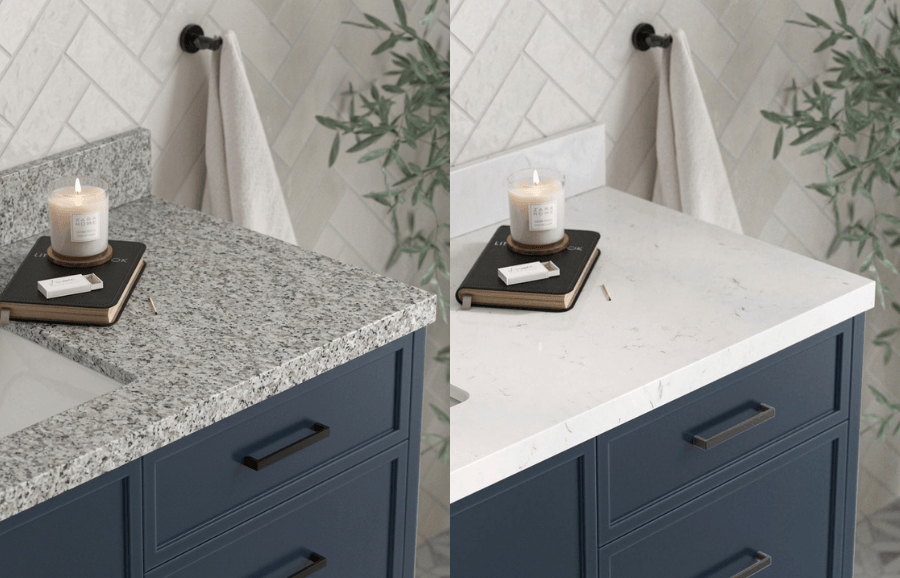
Introduction
For a bathroom vanity, quartz is usually the better fit, because it is non-porous and needs no sealing, while granite's main advantage, heat resistance, matters more in a kitchen. Both are durable surfaces that last for years, so the decision comes down to how each material handles a wet, low-heat space and how much upkeep you want.
ARIEL Bath offers quartz countertops rather than granite, so this guide compares the two materials fairly and then points to the quartz options we carry. The sections below cover what each material is, how they compare across durability, maintenance, heat, appearance, and cost, and which one suits a bathroom.

Quartz vs Granite at a glance
|
Dimension |
Quartz |
Granite |
|
Material type |
Engineered stone: about 90 percent ground quartz bound with resin and pigment |
Natural stone, quarried in slabs |
|
Porosity and sealing |
Non-porous, no sealing needed |
Porous, needs periodic resealing |
|
Durability |
Very durable, resists chips and scratches |
Very durable and hard, though edges can chip |
|
Heat resistance |
Moderate: high heat can damage the resin |
High: handles hot items well |
|
Maintenance |
Low: wipe with a soft damp cloth |
Moderate: reseal periodically to resist stains |
|
Appearance |
Consistent, repeatable color and pattern |
Unique natural veining, varies slab to slab |
|
Best-suited room |
Bathrooms and other lower-heat surfaces |
Kitchens and high-heat surfaces |
What are quartz and granite countertops?
Quartz and granite are both stone surfaces, but one is engineered and one is natural, and that difference drives most of the comparison below.
1. Quartz (engineered stone)
Quartz countertops are engineered from about 90 percent ground natural quartz bound with resin and pigment. Because they are made in a controlled process, the color and pattern are consistent across the slab, and the resin binder makes the surface non-porous. That non-porous surface is the trait that matters most in a bathroom.
2. Granite (natural stone)
Granite countertops are cut from natural stone quarried in slabs. Every slab is different, with veining and color variation that cannot be repeated, which is part of granite's appeal. Because it is a natural stone, granite is porous and needs periodic sealing to keep moisture and stains out.
Quartz vs granite, dimension by dimension
1. Durability
Both materials are hard-wearing and hold up to daily use for years. Quartz resists chips and scratches slightly better because the resin binder gives it some flex. Granite is very hard but can chip at an exposed edge under a sharp impact. For a bathroom vanity, both are more than durable enough.
2. Maintenance and sealing
This is the clearest difference. Quartz is non-porous, so it needs no sealing and cleans with a soft damp cloth. Granite is porous, so it needs resealing periodically to keep water and stains from soaking in. In a bathroom, where the surface meets water every day, the lower-maintenance option is easier to live with.
3. Heat resistance
Granite handles high heat better than quartz, whose resin can be damaged by very hot items. This is a real advantage for granite, but it matters far more in a kitchen than at a vanity, where a countertop rarely meets anything hot. In a bathroom, granite's heat edge has little to do.
4. Appearance and color
Quartz offers consistent, repeatable color and pattern, so what you see in a sample is what you get across the whole top. Granite offers natural variation, with each slab one of a kind. Neither is better. It is a design choice between a uniform look and natural stone character.
5. Cost
Quartz and granite fall in a broadly similar range, and the total depends on the slab, the fabrication, and the upkeep. Granite's periodic resealing adds to its long-term maintenance cost, while quartz needs no sealing.
ARIEL Bath's quartz countertop pricing is listed from $470 on different options, and we also run seasonal sales with countertop discounts, so check the current pricing on the countertop pages for exact figures.

Grantie Kitchen Countertop (Image source: Point3D Commercial Imaging Ltd.)
Which is better for a bathroom vanity?
Quartz suits most bathrooms. A vanity is a wet, low-heat space, which is where quartz is strongest: its non-porous surface resists moisture and stains without sealing, and its lower maintenance holds up to daily use. Quartz's one weakness, heat, rarely comes into play at a bathroom sink.
Granite still makes sense for a homeowner who wants natural stone with unique variation and does not mind resealing it periodically. If that natural character is the priority, granite is a sound choice. For most bathrooms, though, quartz gives you durability and a moisture-resistant surface with less upkeep.
ARIEL Bath's quartz countertop options
ARIEL Bath offers quartz countertops in two types, white and black, so you can go light and clean or deep and defined.
-
White quartz covers Carrara White Quartz, with soft grey veining, and Pure White Quartz, a clean solid white. Both keep a bathroom feeling bright and work with most vanity finishes.
-
Black quartz covers Nero Marquina Quartz, a black surface with white veining, and Carbon Black Quartz, a solid deep black. Both add contrast against a lighter vanity or carry a darker, defined look.
Every one of these is non-porous and suited to a bathroom vanity. For a homeowner who prefers natural stone, ARIEL Bath's Carrara White Marble is the natural-stone alternative it offers.
To care for a quartz top, wipe it with a soft damp cloth and then a dry cloth. Avoid abrasives and harsh cleaners.
Conclusion
For a bathroom vanity, quartz's non-porous, low-maintenance surface is usually the better fit, since a bathroom is a wet, low-heat space where those traits matter most. Granite rewards a homeowner who wants natural variation and will reseal it over time. Both last for years, so the choice comes down to upkeep and the look you want.
If quartz fits your bathroom, you can compare our quartz countertop options directly here.
Frequently Asked Questions
-
Q: Is quartz or granite better for a bathroom?
ARIEL Bath: Quartz is the better fit for most bathrooms because it is non-porous and needs no sealing, which suits a space that meets water every day. Granite works too, but it needs periodic resealing. - Q: Does quartz or granite need sealing?
ARIEL Bath: Granite needs periodic resealing because it is porous. Quartz is non-porous and needs no sealing at all. - Q: Which is more durable, quartz or granite?
ARIEL Bath: Both are very durable. Quartz resists chips and scratches slightly better, while granite is very hard but can chip at an exposed edge. Either lasts for years on a bathroom vanity. - Q: Which is more heat resistant?
ARIEL Bath: Granite handles high heat better than quartz, whose resin can be damaged by very hot items. Heat is rarely a factor at a bathroom vanity, so this matters more in a kitchen. - Q: Which costs more, quartz or granite?
ARIEL Bath: The two fall in a broadly similar range, and the total depends on the slab, fabrication, and upkeep. Granite's resealing adds to its long-term cost. For ARIEL quartz pricing, check our current countertop pages, and look for seasonal sales. - Q: What are the main drawbacks of each?
ARIEL Bath: Quartz can be damaged by high heat and has a more uniform look. Granite is porous and needs resealing, and its natural variation makes slabs harder to match exactly.