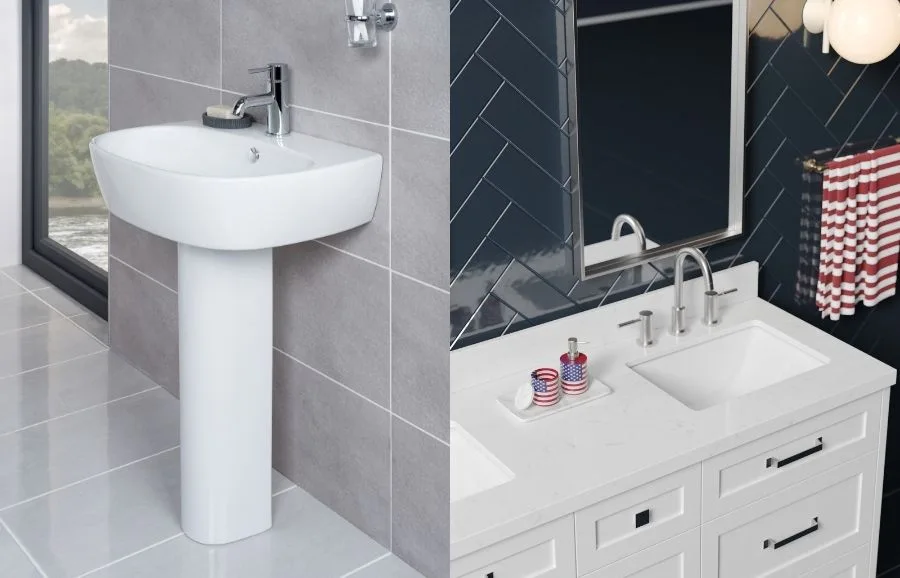
Pedestal vs vanity sinks: what's the difference?
The main difference is storage. A pedestal sink is a basin on a slim column with no storage and no counter, while a vanity is a sink set in a cabinet that adds both.
A pedestal suits a small powder room or a classic look; a vanity suits most bathrooms, and a compact or floating vanity gives even a small bathroom storage without taking much more floor space.
ARIEL Bath sells bathroom vanities with undermount sinks, on their own or paired with a vanity, but not pedestal sinks. So this ARIEL guide compares the two fairly, then points to the vanity and sink options we offer.

Pedestal vs vanity sinks compared at a glance
|
Pedestal sink |
Vanity sink |
|
|
Storage |
None |
Built-in cabinet and drawers |
|
Counter space |
None |
Yes |
|
Floor space |
Saves space |
Takes more space |
|
Plumbing |
Partly exposed, easy to reach |
Concealed in the cabinet |
|
Cost |
Lower upfront |
Higher, with more long-term value |
|
Style range |
Limited, classic |
Wide range of sizes and finishes |
|
Best for |
Small powder rooms, classic looks |
Most bathrooms, storage needs |
What is a pedestal sink, and what is a vanity sink?
The two are built very differently, and that shapes everything below.
Pedestal sink
A pedestal sink is a basin mounted on a slender standing column, or pedestal, that partly hides the plumbing. It has a slim, classic profile that takes up little floor space, which is why it suits small and period-style bathrooms. It has no cabinet, so it offers no storage and no counter.
Vanity sink
A vanity sink is a basin set into or on top of a cabinet, with a countertop around it. The cabinet conceals the plumbing and adds storage, and the counter gives you a place for everyday items. Vanities come in a wide range of sizes, finishes, and configurations.
Does a pedestal sink or a vanity give you more storage?
A vanity gives you far more storage; this is the single biggest difference between the two.
A vanity's cabinet and drawers hold toiletries, towels, and cleaning supplies out of sight. A pedestal sink offers none, so everything has to go somewhere else, a wall cabinet, over-toilet shelving, or a nearby closet.
If your bathroom has no other storage, a pedestal sink will leave the counter and floor cluttered fast.
Which takes up less space in a bathroom?
A pedestal sink takes up less floor space. Because there is no cabinet box extending from the wall, it leaves the floor open and makes a small room feel larger and easier to move around. This is its genuine advantage in a bathroom under about 35 to 40 square feet, such as a half bath or powder room. A vanity has a larger footprint, which is what lets it hold storage, but that footprint can crowd a very small room.
Is a pedestal sink or a vanity better for a small bathroom?
It depends on whether you need storage. If the room is tiny and storage lives elsewhere, a pedestal sink keeps the floor open and the room feeling larger. If you need storage in the room itself, there is a better answer than either extreme: a narrow or floating, wall-mounted vanity. A floating vanity keeps much of the floor visible, like a pedestal, while still giving you a cabinet and counter. It is the middle ground for a small bathroom that a pedestal cannot offer.
How do plumbing and cleaning compare?
A pedestal sink leaves the plumbing partly exposed, which makes the shut-off valves and drain easy to reach and the open base quick to clean around. A vanity conceals the plumbing inside the cabinet for a tidy look from every angle, with the trade-off that you open a cabinet door to reach the connections, and the cabinet surfaces and hardware need occasional cleaning.

Photo by Omar Hakeem on Unsplash
Is a pedestal sink cheaper than a vanity?
A pedestal sink is usually cheaper upfront, both for the fixture and to install. As a general guide, 2026 market figures put a pedestal sink installed at roughly $300 to $1,100, and a vanity at roughly $300 to $3,800 depending on size and material, according to cost data from Angi. These are national averages that vary by location.
The upfront price is only part of the picture. A pedestal saves money at purchase but adds no storage, so you may spend it back on separate storage elsewhere. A vanity costs more but does more, and it tends to add broader resale appeal. For ARIEL vanity pricing, check our product pages and any seasonal sales.
Which suits your bathroom style better?
Both can look right, they set different moods.
- A pedestal sink reads classic, light, and uncluttered, and suits vintage or minimalist bathrooms where the open base is part of the look.
- A vanity offers far more style range, with many finishes, sizes, and countertop options, so it is easier to match to a specific look or to the rest of the bathroom.
Pedestal or vanity sink: which should you choose?
Match the sink to your bathroom and how you use it:
-
Choose a pedestal sink if: the bathroom is a powder room or half bath under about 35 square feet, storage exists elsewhere, and you want a classic, uncluttered look.
-
Choose a vanity if: it is a main or shared bathroom, you need storage and counter space, or you want a wide range of styles and stronger resale appeal.
-
Choose a compact or floating vanity if: the bathroom is small but still needs storage. It keeps the floor open while giving you a cabinet and counter.

ARIEL West 72 Inch Double Rectangular Sink Floating Bathroom Vanity In Warm White
Conclusion
The pedestal-versus-vanity choice comes down to storage against floor space. A pedestal sink saves space and suits a small powder room or a classic look, but offers no storage or counter. A vanity gives you both and suits most bathrooms, and for a small bathroom that still needs storage, a compact or floating vanity is the smarter middle ground. Match the sink to your space and your storage needs, and the right one becomes clear.
Once you know which fits, you can explore ARIEL vanities and sinks directly.
Frequently Asked Questions
-
Q: What is the difference between a pedestal sink and a vanity?
ARIEL Bath: A pedestal sink is a basin on a slim column with no storage or counter, while a vanity is a sink set in a cabinet that adds storage and counter space and conceals the plumbing. Storage is the biggest difference. - Q: Is a pedestal sink or a vanity better for a small bathroom?
ARIEL Bath: A pedestal sink saves the most floor space and suits a tiny bathroom where storage exists elsewhere. If a small bathroom still needs storage, a narrow or floating vanity is the better choice, keeping the floor open while adding a cabinet. - Q: Do pedestal sinks have storage?
ARIEL Bath: No. A pedestal sink has no cabinet or drawers, so storage has to go elsewhere, such as a wall cabinet, over-toilet shelving, or a nearby closet. - Q: Which adds more resale value, a pedestal sink or a vanity?
ARIEL Bath: A vanity has broader appeal because of its storage, so it is the safer bet for resale in most bathrooms. A pedestal sink can still work in a well-styled powder room. - Q: Can you get storage with a small bathroom sink?
ARIEL Bath: Yes. A narrow or floating, wall-mounted vanity gives you a cabinet and counter while keeping much of the floor open, which a pedestal sink cannot do.