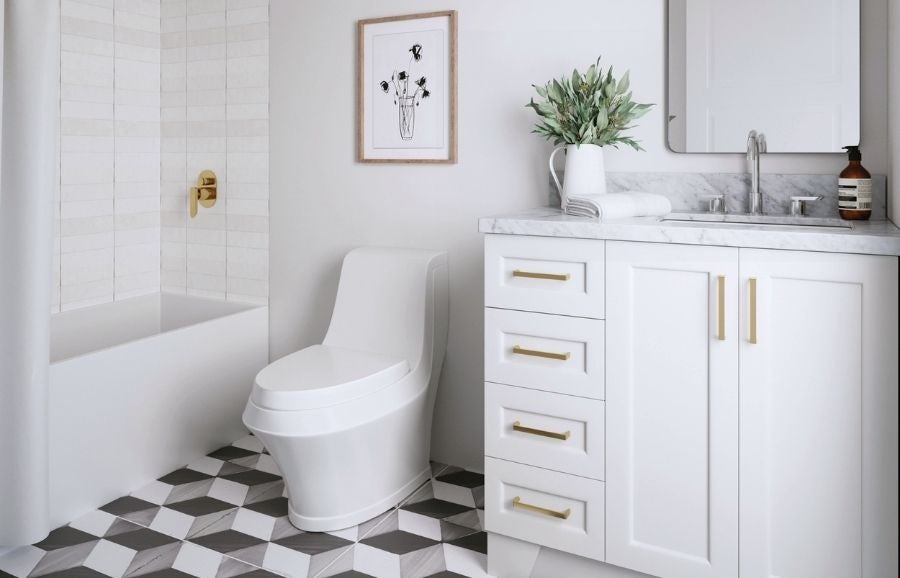
To make a small bathroom look bigger, focus on opening up sightlines and reflecting light: use a light, consistent color palette, hang a large mirror, choose a floating vanity that exposes the floor, swap a solid shower enclosure for clear glass, and run continuous flooring.
None of these change the room's actual size, but together they make it feel noticeably more open. Here are 08 ways to do it, from color and lighting to the fixtures you choose.
1. Use light, consistent colors
Light colors make a small bathroom feel bigger because they reflect more light and reduce hard contrast that visually chops up the space. White and soft, pale shades work best, and you can carry them from floor to ceiling. A few guidelines:
-
Limit the room to about two colors so it reads as calm rather than busy.
-
Keep walls a lighter shade than the floor, and the ceiling the same or lighter than the walls.
-
If you use tile, choose large, light-colored tiles and match the grout close to the tile color so the surface reads as continuous.
A light-finish vanity supports the same effect. You can browse our white vanities to keep the palette consistent.
2. Hang a large mirror
A large mirror is the most effective single trick for a small bathroom, because it reflects the room and the light back at you, which visually doubles the space. Go as large as the wall allows, and place it opposite or beside a window so it bounces daylight into darker corners. A mirror that spans the full width of the vanity does more than a small one.
3. Choose a floating vanity
A floating (wall-mounted) vanity makes a small bathroom look bigger by exposing the floor beneath it, which reads as more open space. Seeing the floor run continuously under the vanity tricks the eye into perceiving a larger room, and it also makes cleaning easier. It's the highest-impact furniture choice for a tight bathroom.
Look for an ARIEL floating vanity scaled to your space, or browse our small bathroom vanities sized to fit.

ARIEL Hutton 60 In. Double Sink Floating Wall Cabinet In White
4. Maximize light
A bright bathroom feels bigger than a dim one, so make the most of every light source. If you have a window, keep it unobstructed and let the daylight in. Add layered lighting, such as recessed ceiling lights and fixtures integrated into the mirror or walls, so there are no dark corners. In a windowless bathroom, brighter overall lighting does the most to open up the room.
5. Use glass instead of a solid shower enclosure
A clear glass shower door keeps a small bathroom feeling open, because you can see straight through to the far wall. A solid or opaque shower curtain cuts the room in half visually and makes it feel smaller. A clear glass panel or a transparent curtain preserves the full sightline and makes the whole space read as one room.
6. Keep fixtures compact and simple
Fixtures with clean, simple lines and a footprint scaled to the room keep a small bathroom from feeling crowded. Bulky, ornate pieces eat visual space; streamlined ones leave the room feeling open.
Choose a vanity sized to your bathroom rather than the largest one that fits, and favor wall-mounted fixtures where you can. A small bathroom vanity in a simple profile is an easy way to get this right.
7. Declutter and add smart storage
Less clutter on display makes a small bathroom feel instantly larger, so give everything a place to be put away. Visual busyness, bottles and items left out on the counter, is what makes a small room feel cramped.
Use vanity drawers and organizers to keep essentials out of sight, and add vertical storage to use wall height rather than floor space. Explore ARIEL storage options that fit a tight footprint.

8. Use continuous flooring
A continuous, low-contrast floor makes a small bathroom look bigger by removing the visual breaks that make a room feel divided. Choose large-format tile or a continuous wood-look floor rather than small, busy patterns. If you use planks, run them lengthwise to draw the eye down the length of the room. Avoid sharp demarcations or thresholds that cut the floor into sections.
Consider a Pocket or Sliding Door
If your layout allows it, a pocket or sliding door frees up the floor space a swinging door needs. In a tight bathroom, a door that slides along the wall removes the clearance a standard door requires, giving you more usable room.
Conclusion
Making a small bathroom look bigger comes down to light and sightlines: a light, consistent palette, a large mirror, a floating vanity that shows the floor, clear glass, and continuous flooring. Start with the mirror and the vanity, since they make the biggest difference, then layer in color, lighting, and storage.
For vanities in every size, browse our small and large bathroom vanity ranges.
Frequently Asked Questions
-
Q: How do you make a small bathroom look bigger?
ARIEL Bath: Use a light, consistent color palette, a large mirror, a floating vanity that exposes the floor, a clear glass shower, and continuous flooring. Together these open up sightlines and reflect light, so the room feels more spacious. - Q: What color makes a small bathroom look bigger?
ARIEL Bath: Light colors, especially white and soft pale shades, make a small bathroom look bigger because they reflect light and reduce contrast. Keeping the room to about two colors helps it feel calm and open. - Q: Do mirrors make a bathroom look bigger?
ARIEL Bath: Yes. A large mirror reflects the room and its light, which visually expands the space. Placing it near a window to bounce daylight has the strongest effect. - Q: Does a floating vanity make a bathroom look bigger?
ARIEL Bath: Yes. A floating vanity exposes the floor beneath it, and seeing the floor run continuously makes the room read as larger. - Q: What flooring makes a small bathroom look bigger?
ARIEL Bath: Large-format tile or continuous wood-look flooring, in a light, low-contrast shade, makes a small bathroom look bigger by removing the visual breaks that divide a room.