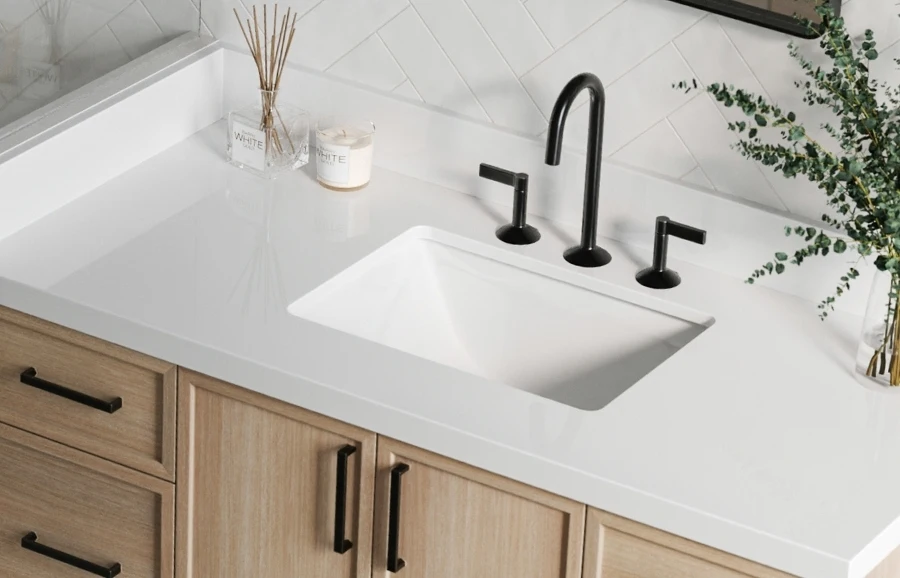
What are the best budget-friendly bathroom countertop materials?
Laminate and tile are the cheapest bathroom countertop materials upfront, at roughly $25 to $50 and $10 to $40 per square foot installed in 2026.
But for a bathroom vanity, which uses a small amount of countertop, the best value is usually a more durable, low-maintenance material like Quartz, especially when the top comes fitted with the vanity so you skip the separate fabrication and installation costs.
These are 2026 national averages and vary by location, collected from verified sources and our insights. This ARIEL official guide ranks the common materials by cost, then explains why the cheapest option is not always the best value for a bathroom.

What affects countertop cost
A few things drive the price of a bathroom countertop:
-
Material: The single biggest factor, from budget laminate to higher-cost natural stone.
-
Square footage: A bathroom vanity uses far less countertop than a kitchen, so the material cost is much lower.
-
Fabrication and installation: Cutting, finishing, and fitting a slab runs roughly 35 to 55 percent of a typical installed countertop cost.
-
Edge profile and extras: A simple edge costs less than a decorative one.
-
How you buy it: A slab, a stone remnant, or a top that comes with the vanity all cost differently.
Bathroom countertop materials, ranked by budget
Here is how the common materials compare on installed cost per square foot in 2026. These are national averages and vary by location.
|
Material |
Installed cost per sq ft (2026) |
Budget note |
|
Laminate |
About $25 to $50 |
Cheapest upfront; less durable, water-susceptible |
|
Ceramic or porcelain tile |
About $10 to $40 |
Hard-wearing; grout lines to maintain |
|
Cultured marble |
About $10 to $40 |
Budget marble look |
|
Solid surface (such as Corian) |
About $40 to $60 |
Non-porous, seamless, low maintenance |
|
Butcher block or wood |
About $55 to $110 |
Warm look; needs oiling and sealing, water-vulnerable |
|
Quartz (entry to mid) |
About $50 to $150 |
Best long-term value; non-porous, no sealing |
|
Granite |
About $40 to $175 |
Durable; needs periodic sealing |
|
Natural marble |
About $65 to $250 |
Higher cost; needs sealing |
A short profile of each:
-
Laminate is the lowest upfront cost and today's styles mimic stone well, but it is less durable and can be damaged by water over time.
-
Ceramic or porcelain tile is hard-wearing and inexpensive, with grout lines that need cleaning and can stain.
-
Cultured marble gives a marble look at a low price, molded in one piece.
-
Solid surface is non-porous, seamless, and low-maintenance at a moderate price.
-
Butcher block brings warmth but needs regular oiling and sealing and is vulnerable to water, which matters in a bathroom.
-
Quartz is non-porous, needs no sealing, and lasts for years, which is why it offers the best long-term value.
-
Granite is durable and natural but needs periodic sealing.
-
Natural marble has a distinctive look but costs the most in this group and needs sealing.
Cheapest top material isn't always the best value
The lowest upfront price and the lowest lifetime cost are not the same thing. Materials that need ongoing sealing or oiling, like natural marble and butcher block, cost more over their life than materials that need neither. Laminate and tile are cheap to buy but wear faster in a wet bathroom.
Two things work in your favor with a bathroom vanity. First, the top is small, so even a higher-quality material costs far less than it would in a kitchen. Second, a durable, low-maintenance surface saves you money and effort every year you own it.
That combination is why quartz, non-porous, no sealing, and long-lasting, tends to be the best value for a bathroom vanity even though it is not the cheapest material on the shelf.

Carrara White Quartz and Pure White Quartz Countertop
How to get a quality countertop on a budget
A few choices stretch the budget:
-
Use the small footprint to your advantage: A vanity top uses little material, so upgrading the material barely moves the total.
-
Choose a top that comes fabricated and fitted: A countertop that arrives with the vanity removes the separate slab, fabrication, and installation costs that make up much of a typical countertop bill.
-
Consider marble-look quartz: It gives the look of marble without marble's cost or its sealing schedule.
-
Keep the edge simple: A clean, standard edge costs less and looks right in most bathrooms.
An ARIEL Bath vanity includes the quartz or marble countertop, an undermount sink, and a 4-inch backsplash and ships free, so the top is not a separate slab-plus-fabrication cost on top of the cabinet. For our current pricing and any seasonal sales, check the product pages.
ARIEL Bath countertop options
ARIEL Bath offers countertops two ways: fitted with a vanity, or as a standalone countertop. Both come in the same quartz options, and buying the top with a vanity means there is no separate slab or fabrication cost.
Fitted with a vanity, five options are available:
-
Carrara White Quartz and Pure White Quartz (white quartz)
-
Carbon Black Quartz and Nero Marquina Quartz (black quartz)
-
Carrara White Marble (natural stone)
As a standalone countertop, four quartz options are available; marble is offered only with a vanity:
-
Carrara White Quartz
-
Pure White Quartz
-
Carbon Black Quartz
-
Nero Marquina Quartz
The quartz options are non-porous, need no sealing, and give the best long-term value. Carrara White Quartz offers a marble look without marble's cost or maintenance. The Carrara White Marble top is the natural-stone choice for those who want real marble, and it needs periodic resealing to stay protected.

Carbon Black Quartz Countertop Option
Conclusion
For pure upfront price, laminate and tile are the cheapest bathroom countertop materials. But because a vanity top is small, spending a little more on a durable, low-maintenance material like quartz is usually the better value, and it costs less to live with over the years.
Choosing a top that comes fitted with the vanity removes the separate fabrication and installation costs, which is the clearest way to get a quality countertop on a budget. Once you know your material, you can compare our countertop options directly.
Frequently Asked Questions
-
Q: What is the cheapest bathroom countertop material?
ARIEL Bath: Laminate is the cheapest, at roughly $25 to $50 per square foot installed in 2026, followed by ceramic or porcelain tile at about $10 to $40. Both are inexpensive upfront but less durable in a wet bathroom than stone or quartz. - Q: What is the best budget countertop that still looks good?
ARIEL Bath: Entry-level quartz is the best-value pick that still looks good, and marble-look quartz gives the appearance of marble without its cost or sealing. Because a vanity top is small, quartz is more affordable in a bathroom than in a kitchen. - Q: How much does a bathroom countertop cost?
ARIEL Bath: In 2026, installed costs run roughly $25 to $50 per square foot for laminate, $40 to $60 for solid surface, $50 to $150 for quartz, $40 to $175 for granite, and $65 to $250 for natural marble. A small vanity top uses little material, so the total is much lower than a kitchen. - Q: Is quartz affordable for a bathroom?
ARIEL Bath: Yes. A vanity uses little countertop, so quartz costs far less than in a kitchen, and an ARIEL vanity includes the quartz top with the cabinet, so there is no separate slab or fabrication cost. - Q: What is the best-value countertop long term?
ARIEL Bath: Quartz. It is non-porous, needs no sealing, and lasts for years, so it costs less to maintain than materials like marble or butcher block that need regular sealing or oiling. - Q: How can I save on a bathroom countertop?
ARIEL Bath: Use the small footprint to your advantage, choose a top that comes fabricated and fitted with the vanity, consider marble-look quartz instead of natural marble, and keep the edge profile simple.