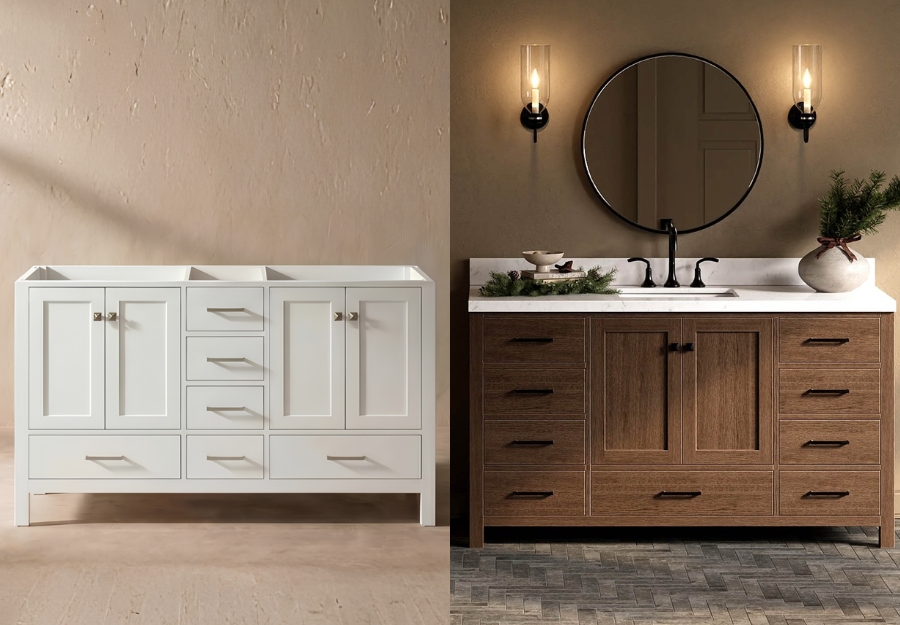
Should you buy a vanity with a top or without one?
For most bathrooms, the vanity with its top is the better buy. A vanity supplied with its top arrives with the undermount sink already fitted and the faucet holes already drilled, so the finished height is known before anything is unpacked and the install is a set-and-connect job.
Buy the base cabinet on its own in three cases: you are keeping a countertop you already have, the vanity sits in a longer run that needs one continuous surface, or you want a different countertop material. Saving money alone is not a strong reason, because you still have to buy the top, the sink and the drilling separately.
What's included at ARIEL Bath: vanity with top vs. base cabinet only
A vanity with a top is a finished unit, and a vanity without a top is the cabinet alone. In ARIEL product codes, the letters BC mark the cabinet-only version.
With the top, you receive the cabinet, the countertop, the undermount sink already fitted to the underside of the top, and the faucet holes already drilled, plus a free backsplash. The faucet itself is not included. The finished vanity is deeper and taller than the cabinet alone, by the countertop's overhang and thickness.
Without the top, you receive the cabinet. It is 21.5 inches deep and 34.5 inches high. The surface, the sink, the cutout and the drilling are all yours to arrange.
That extra depth and height is not a rounding error. It is the top sitting on the cabinet, and it moves the finished surface your faucet rises from and your mirror hangs above. If you are matching a vanity to an existing mirror or a tiled backsplash that stops at a set line, measure from the finished height rather than the cabinet height.

ARIEL Cambridge 36 Inch Left Offset Single Rectangle Sink Bathroom Vanity In Brown Oak
Vanity with top compared with vanity without top
|
With the top |
Without the top |
|
|
What arrives |
Cabinet, top, sink fitted, holes drilled (no faucet), free backsplash |
Cabinet only |
|
Depth |
21.5 inches plus the countertop overhang |
21.5 inches |
|
Finished height |
34.5 inches plus the countertop thickness |
34.5 inches, before any top |
|
Sink |
Undermount, fitted |
You supply and fit it |
|
Faucet holes |
Drilled |
You or your fabricator drill them |
|
Surface choice |
ARIEL quartz or marble options |
Any surface you can source |
|
Install |
Set, level, connect |
Set, level, fit the top, seal, connect |
|
Deliveries |
One shipment |
Cabinet from ARIEL, top and sink from wherever you source them |
|
What can go wrong |
Little. The parts are matched |
Cutout, hole spacing, overhang and height all have to be got right |
*The last row is the one worth reading twice. Every line in the right-hand column is a decision somebody has to make correctly, and a top cut for the wrong sink cannot be recut.
Buy the vanity with its top if
Buy the vanity with its top if you are replacing a vanity in a standard opening and have no surface worth keeping. This covers most bathroom refreshes.
The reason is not convenience for its own sake. It is that the parts are matched before they leave the warehouse. The cutout fits the sink because it was cut for that sink. The faucet holes are where the faucet goes. The overhang is set. Everything arrives in one shipment, with the cabinet and top in separate packages, and the number of things that can be wrong on the day drops to the plumbing.
This is also the right call if you are hiring the install. An installer setting a finished vanity is doing a predictable job. An installer who arrives to find a cabinet, a loose top and a sink in a separate box is doing a longer one.
Buy the base cabinet if
Buy the base cabinet if you already have the surface. Four situations make it the right choice:
-
You are keeping a countertop in good condition: A stone top that is sound and the right size is worth more than the saving on a new one.
-
The run needs one continuous surface: A vanity that sits in a longer counter run, or next to a built-in, needs a top cut as one piece. A pre-fitted top cannot do that.
-
You want a different countertop material: If the room is built around a specific stone ARIEL does not offer, the cabinet is the part to buy and the surface is the part to source.
-
The opening is not a standard width: A fabricator can cut to the opening. A supplied top cannot.
If you buy the cabinet on its own and still want an ARIEL surface, the quartz countertops are sold separately in Pure White, Carrara White, Carbon Black and Nero Marquina.
If none of those four describes your bathroom, the base cabinet is probably not the right buy. Price on its own is a weak reason, and the next section explains why.

ARIEL Bayhill 48 In. Single Sink Base Cabinet In Grey
Four things to check before buying a vanity without a top
Four measurements decide whether a base cabinet and a separate top will meet. Check all four before ordering either part.
- The sink cutout: The top has to be cut for the sink you are using, and the cut has to match the sink's mounting style. An undermount sink is fixed below the surface and needs a polished cutout edge. A drop-in sink sits in the hole with its rim on the surface. The two cuts are not interchangeable, and a top cut for one cannot be recut for the other.
- The faucet hole spacing: Three spacings cover most faucets: a single hole, a centerset at 4 inches between the outer holes, and a widespread at 8 inches. Order the top drilled for the faucet you own, or buy the faucet first. Drilling stone after the fact is possible and is not something to plan for.
- The overhang: The top usually runs past the cabinet front by a small margin. That margin is what keeps water off the drawer fronts, and it is also what determines whether the drawer pulls clear the edge. Check the overhang the top gives you against the cabinet you are buying rather than assuming they agree.
- The finished height: The top adds to the cabinet height. An ARIEL base cabinet is 34.5 inches high, and the countertop's thickness sits on top of that. Work out where your faucet, mirror and backsplash land from the finished height, not from the cabinet.
If any of the four is uncertain, the vanity supplied with its top removes all four questions at once.
Is it cheaper to buy a vanity without a top?
A base cabinet costs less than the same vanity with its top, and whether you end up spending less depends entirely on whether you already own a usable surface.
An ARIEL vanity with its top is priced all-in: the cabinet, the top, the fitted sink, the drilled faucet holes and a free backsplash come in one price. A base cabinet is cheaper on its own, but everything else has to be bought and added up separately.
If you do, the saving is real and straightforward. If you do not, four things come back onto the bill: the surface itself, the sink, the cutting and drilling, and a second delivery. A stone top is heavy and is usually shipped on its own. Fabrication is priced separately from the slab. By the time those are added, the gap between the two routes narrows, and the base-only route has taken on the four risks above.
The honest version of the answer is this. Buying without a top is a way to choose your surface. It is not reliably a way to spend less. If spending less is the goal, budget-friendly countertop materials is the more useful comparison, and a vanity with a quartz top supplied often lands below a cabinet plus a fabricated stone surface.

ARIEL Hamlet 37 In. Right Offset Oval Sink Vanity In White
How to measure for a vanity top
Measure the width at the front of the cabinet and again at the back, and take the depth from the front edge to the wall. The two width measurements can differ, because walls are rarely parallel, and the top has to clear the narrower of the two.
Then mark where the sink centre needs to land. On a single-sink vanity it is usually centred on the cabinet, but on an offset configuration it is not, and on a double it has to agree with the drain positions below. Give the fabricator the cabinet, not an assumption about it.
If you are still choosing a width, the vanity sizing guide covers what fits in a given bathroom. A separate guide to vanity top sizes, overhang and sink cutouts is in preparation and will cover the dimensions in more detail.
Can you reuse your existing countertop?
You can reuse an existing countertop if the new cabinet matches the old footprint and the top comes off in one piece. Both conditions have to hold, and the second is the one that catches people out.
Stone tops are usually bedded on silicone or adhesive and are heavy enough that leverage breaks them. A top that has been down for years often does not survive removal, and a quartz or marble slab cracks at the sink cutout, which is its weakest line. If the top is coming off anyway as part of the work, have it lifted before you order the cabinet, so you know what you are working with.
If the footprint has changed at all, the answer is no. A top cut for a 48 inch cabinet does not fit a 49 inch one, and the overhang that looked generous on the old unit becomes a gap on the new one.
Conclusion
Buy the vanity with its top unless you already own the surface. The sink is fitted, the holes are drilled, the height is known, and the four things that can go wrong on a base-only build are decided for you before delivery. Buy the cabinet on its own when you are keeping a sound countertop, fitting a continuous run, using a different countertop material, or working to a width no standard top will meet.
If the base cabinet is the right answer for your bathroom, the vanities without tops range is where to start. To pair it with an ARIEL surface, the quartz countertops are sold separately.
Frequently Asked Questions
-
Q: Can I buy an ARIEL bathroom vanity without a top?
ARIEL Bath: Yes. ARIEL supplies cabinet-only versions of most of its vanities, in widths from 30 to 72 inches, marked with BC in the product code. You receive the cabinet and supply the surface and sink yourself. - Q: Does a vanity without a top come with the sink?
ARIEL Bath: No. The sink is fitted to the underside of the top, so a cabinet supplied without a top has no sink with it. - Q: Are the faucet holes already drilled in an ARIEL vanity top?
ARIEL Bath: Yes, on vanities supplied with their top. The holes are drilled before shipping, but the faucet is not included, so check the spacing against the faucet you plan to use. - Q: What is the difference between a vanity top and a countertop?
ARIEL Bath: A vanity top is a countertop made for a bathroom vanity, usually supplied with the sink cutout and the faucet holes already in it. A countertop is the general term for the surface. - Q: Is a vanity base cabinet the same height as a finished vanity?
ARIEL Bath: No. An ARIEL base cabinet is 34.5 inches high. The same vanity supplied with its top finishes higher by the countertop's thickness, because the top sits on the cabinet.