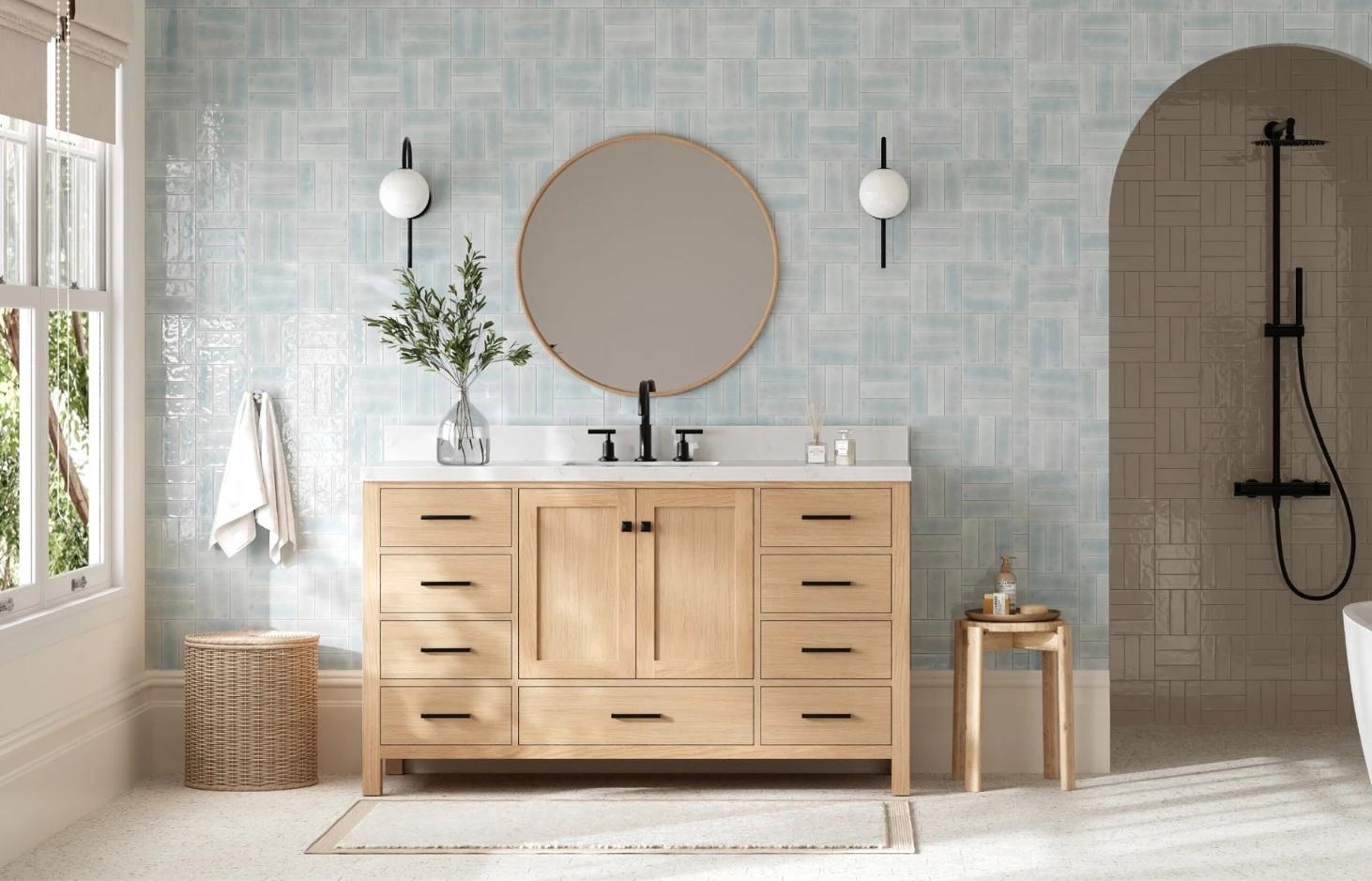
Best oak bathroom vanities by finish
ARIEL Bath offers oak bathroom vanities in two finishes: a natural light oak and a warmer brown oak. Choose the natural light oak to brighten a small or low-light bathroom and suit almost any style, or the brown oak for a warmer, richer look that anchors a larger or more traditional space.
Both are solid oak, sealed against moisture, and available in floating and freestanding styles from 30 to 72 inches.
This ARIEL Bath guide covers the two oak finishes, how to choose between them, and how to match oak to the rest of your bathroom.

Why choose solid oak, not an oak-look laminate
Much of what is sold as an "oak" vanity is a printed laminate or veneer over particleboard, which can peel or swell in a wet bathroom. ARIEL oak vanities are real solid oak with visible wood grain, sealed with a water-resistant finish to resist moisture and warping. Solid oak holds up in a bathroom and can be lived with for years, which is the first thing to look for in any oak vanity.
ARIEL Bath's two Oak finishes
The choice of oak comes down to tone. Here is what each finish offers and who it suits.
Natural oak: light and versatile
ARIEL's natural oak is a light, beige, organic finish with warm, visible grain. It reflects light, which makes it a strong choice for small or low-light bathrooms, and its neutral tone works with almost any style, from modern to farmhouse. It is the more versatile of the two and the easier one to pair with white or light countertops and walls.
Natural oak is available across the widest range of ARIEL collections, including Hepburn, Kelly, Cambridge, Monroe, Taylor, Camila, Lucia, Loren, and West.
Brown oak: warm and rich
ARIEL's brown oak is a warm, cinnamon-toned wood grain, distinctly darker than the natural oak. It brings more depth and warmth, which makes it a stronger statement and a better anchor for a larger bathroom or a more traditional look. It pairs well with cream and warm-toned surfaces, and with either a white or a black countertop for contrast.
Brown oak is available in the Hepburn, Cambridge, and Loren collections.
*We have also offered a black oak finish, though it is not currently available.

How to choose between natural oak and brown oak
Pick your oak finish by the room, not in isolation. A few things to weigh:
-
Room size and light: Natural light oak reflects light and keeps a small or windowless bathroom feeling open. Brown oak absorbs more light, so it suits a larger or well-lit room where you want warmth and depth.
-
Undertones: Look at the tile, floor, and countertop already in the room. Warm beige and cream surfaces sit well with either oak; cooler greys and bright whites tend to favor the neutral light oak.
-
The look you want: Natural oak reads calm and versatile; brown oak makes more of a statement.
-
Lighting: Test a finish sample under your bathroom's actual lighting, since warm bulbs make oak look more golden and cool bulbs bring out its neutral or grey notes.
ARIEL oak vanity sizes and configurations
Both oak finishes come in the same range of sizes and setups, so you can match the finish to your space without giving up options:
-
Sizes: 30 to 72 inches.
-
Profiles: floating (wall-mounted) or freestanding. A floating oak vanity keeps more of the floor visible, which adds to the light, open effect in a small bathroom.
-
Sink options: single or double.
-
Included: each vanity ships as a complete set with a quartz or marble countertop and sink, and a matching backsplash, so the top is not a separate purchase.
Conclusion
The best oak bathroom vanity for you comes down to finish and fit. Natural light oak brightens a small or low-light bathroom and works with almost any style, while brown oak brings warmth and depth to a larger or more traditional space.
Both are solid oak, sealed against moisture, and come as a complete set with a quartz top. Match the tone to your room's size, light, and undertones, and either finish will look right for years.
Once you know your finish, you can compare oak vanities directly.
Frequently Asked Questions
-
Q: Is oak a good choice for a bathroom vanity?
ARIEL Bath: Yes, as long as it is solid oak with a sealed, water-resistant finish rather than an oak-look laminate. Solid oak handles bathroom humidity and lasts, and it brings warm, natural grain that a painted cabinet does not. - Q: What oak finishes does ARIEL Bath offer?
ARIEL Bath: ARIEL Bath offers two oak finishes: a natural light oak, which is beige and organic, and a brown oak, which is a warmer cinnamon tone. A black oak has also been offered but is not currently available. - Q: Is light oak or brown oak better?
ARIEL Bath: Neither is better on its own. Light oak reflects light and suits small, low-light, or modern bathrooms, while brown oak brings warmth and depth to a larger or more traditional space. Choose by your room's size, light, and undertones. - Q: What countertop goes with an oak vanity?
ARIEL Bath: Light oak pairs cleanly with white quartz or a marble-look top; brown oak works with white for brightness or a black quartz for contrast. ARIEL oak vanities come with a quartz or marble top included. - Q: What size oak vanity is best for a small bathroom?
ARIEL Bath: A 30- to 36-inch oak vanity suits a small bathroom, and a floating, wall-mounted version in natural light oak keeps the floor visible and the room feeling open. - Q: Is ARIEL oak solid wood or veneer?
ARIEL Bath: ARIEL oak vanities are solid oak with a water-resistant finish, not a printed laminate or veneer over particleboard, and are backed by a 3-year warranty.