Introduction
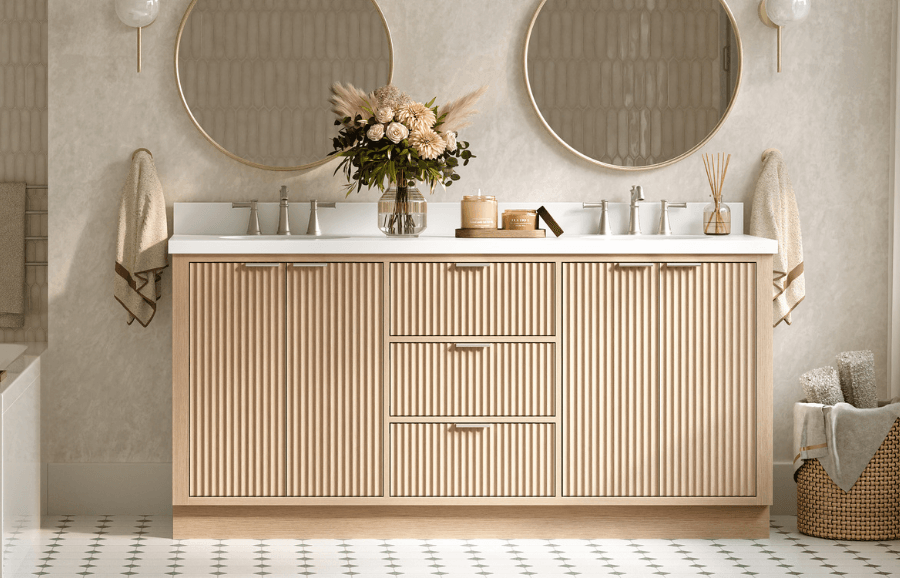
A double sink vanity is worth it if you share a bathroom and have the space for it, generally at least 60 inches of width.
Two sinks let two people get ready at the same time, add storage, and give each person their own area, which is why they're a common choice for couples, families, and shared bathrooms.
In a small bathroom or a bathroom used by one person, a single sink vanity is usually the better use of the space. This guide covers the pros, the trade-offs, how much space you need, whether a double vanity adds home value, and how to choose materials and finishes.
Who a Double Sink Vanity Is Right For
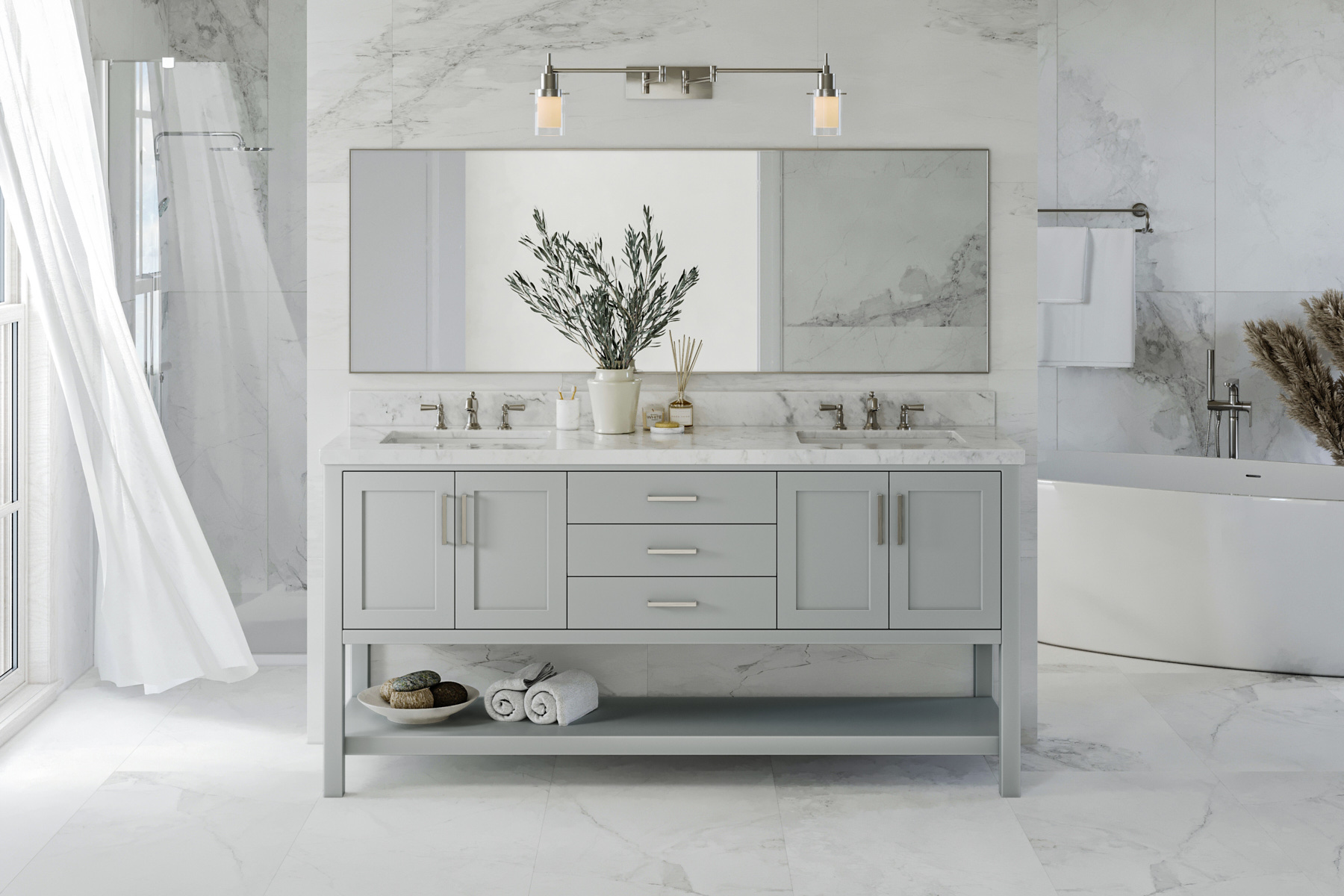
A double sink vanity makes the most sense when more than one person uses the bathroom at the same time. For couples, families, and roommates, two sinks remove the main friction point of a shared morning routine by letting both people use the space at once instead of taking turns.
It's less worth it in two cases: a bathroom used by one person, where the second sink mostly goes unused, and a small bathroom, where fitting two sinks leaves too little counter space to be practical. In those situations, a wider single-sink vanity often serves better.
Double Sink vs. Single Sink Vanity
The choice between a double and single vanity comes down to how many people use the bathroom and how much width you have. A double vanity adds simultaneous access and storage; a single vanity fits smaller spaces and leaves more uninterrupted counter space.
|
Double Sink Vanity |
Single Sink Vanity |
|
|
Simultaneous use |
Two people at once |
One at a time |
|
Width needed |
60 inches or more |
Fits under 60 inches |
|
Storage |
More cabinets and drawers |
Less overall |
|
Counter space |
Split between two sinks |
One continuous surface |
|
Plumbing |
Two sink connections |
One |
|
Best for |
Shared primary bathrooms |
Small or single-user bathrooms |
You can compare options directly on the ARIEL double sink vanity and single sink vanity pages.

Ariel Stafford 61 In. Double Sink Vanity With White Quartz Countertop In White l Ariel Stafford 37 In.Single Sink Vanity With White Quartz Countertop In White
The Pros of a Double Sink Vanity
The main advantage of a double sink vanity is that two people can use it at once, but the benefits go beyond that. The most common reasons people choose one:
-
Simultaneous use: Two sinks mean no waiting during busy mornings, which is the biggest day-to-day benefit for shared bathrooms.
-
More storage: The extra width usually comes with more cabinets and drawers for toiletries, towels, and essentials.
-
Personal space: Each person gets their own sink and area to organize their things, which cuts down on shared clutter.
-
Buyer appeal: In larger primary bathrooms, a double vanity is a feature many buyers expect, which can help at resale (more on that below).
The Trade-offs to Consider
A double sink vanity also has real trade-offs, and they mostly come down to space and cost. Weigh these before deciding:
-
It needs width: Two sinks require at least 60 inches, and a comfortable layout usually wants more. In a narrow bathroom, a double vanity crowds the room.
-
Less uninterrupted counter space: More plumbing. A second sink needs its own water supply and drain connections, which adds to installation cost.
-
Not always used: If only one person uses the bathroom, the second sink adds cost without much daily benefit.
In a bathroom under 60 inches wide, or one used by a single person, a well-designed single sink vanity is often the smarter choice.
Does a Double Vanity Add Home Value?
A double vanity can support home value, mainly in a primary bathroom that's large enough to fit it comfortably. Updated bathrooms tend to hold their value well: nationally, a midrange bathroom remodel recouped about 80% of its cost at resale in 2025, its highest level since 2007, according to the 2025 Cost vs. Value Report from Zonda Media.
For double vanities specifically, the value is context-dependent. In mid-range to high-end homes, buyers increasingly expect a double vanity in the primary suite, and its absence can make the bathroom feel dated by comparison.
In a guest bath, a powder room, or a small bathroom, a second sink adds little, and a cramped double that's squeezed into too little space can hurt appeal more than a well-executed single. If resale is a goal, the practical takeaway is to add a double vanity only where the bathroom is genuinely large enough for it.
What Size Do You Need for a Double Sink Vanity?
You need at least 60 inches of width for a double sink vanity, which is the minimum for two sinks to fit. ARIEL double sink vanities range from 60 to 72 inches wide, while single sink vanities run from 30 to 66 inches, so in the 60 to 66 inch overlap either configuration can fit, and the right one depends on how many people share the bathroom.
Our standard vanity depth is 22 inches and standard height is 36 inches. Widths above 72 inches, such as 85-inch options, are vanity and linen cabinet sets rather than standalone double vanities, so measure for the vanity and the tower separately if you're considering one.
For full measurements and clearances, see our vanity sizing guide.
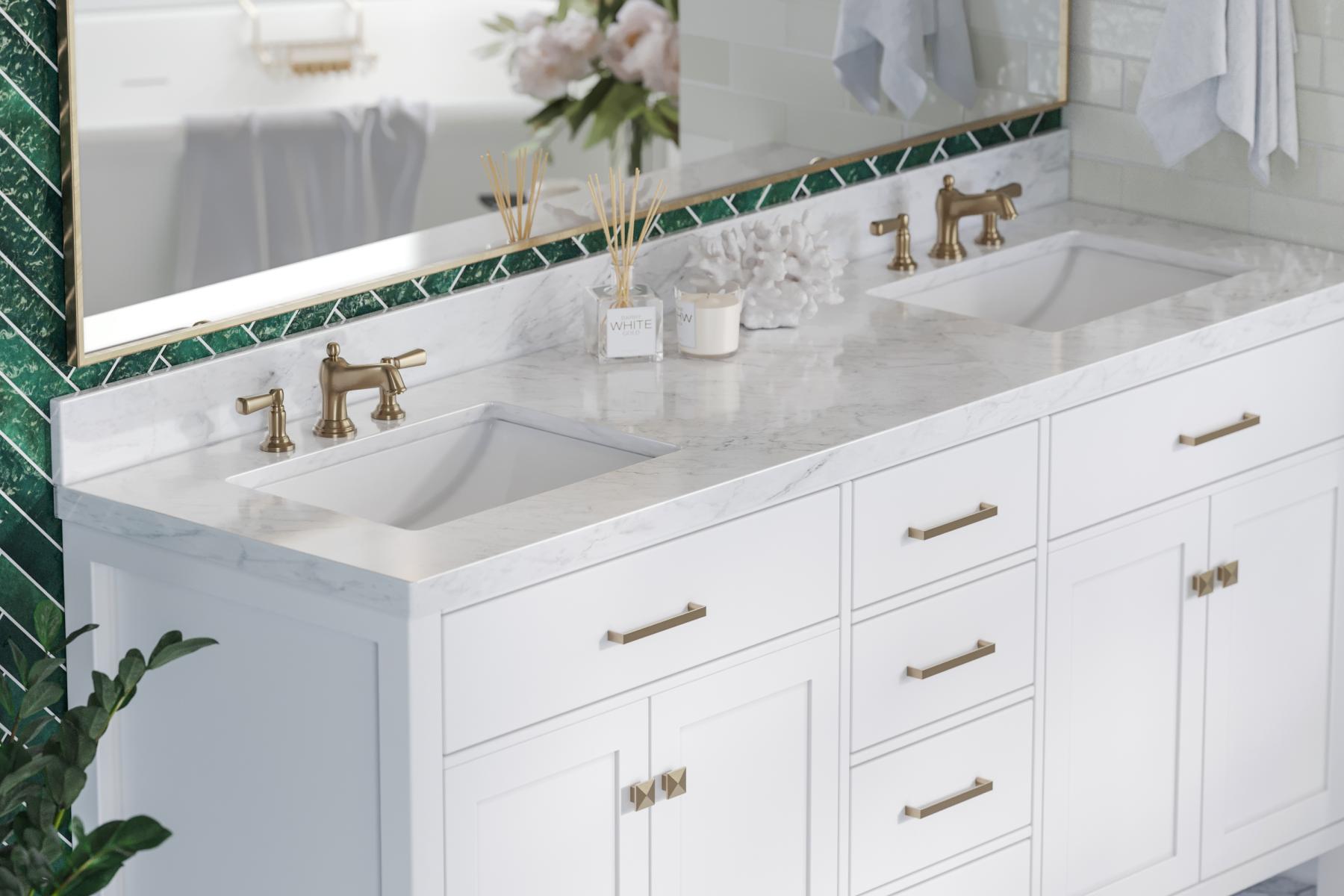
ARIEL Bristol 73 In. With Carrara White Marble Countertop In White And Satin Brass Hardware
Choosing Materials and Finishes
Once you've settled on a double vanity, the main decisions are the countertop, the cabinet, the sinks, and the hardware finish. Each affects both durability and look.
-
Countertops: ARIEL Bath offers Carrara White Marble, Carrara White Quartz, Pure White Quartz, Nero Marquina Quartz, and Carbon Black Quartz. Quartz is low-maintenance and uniform; marble has natural veining and needs a bit more care.
-
Cabinet construction: ARIEL vanities are hand-crafted from solid wood and plywood and finished with Sherwin-Williams polyurethane (PU) paint for a hard, durable surface. Drawer boxes are solid wood with dovetail joinery, and all drawers and doors close on soft-close hardware.
-
Sinks: All ARIEL sinks are undermount, so the choices are the shape, rectangular or oval, and the offset, left, right, or center, to match your layout.
-
Hardware finish: Vanities are available in satin brass, brushed nickel, polished chrome, and matte black, which lets you set the contrast against the cabinet color.
For style direction, the contemporary and minimalist ranges show how these choices come together, and you can compare surfaces on the countertops page.
Conclusion
A double sink vanity is worth it when you share a bathroom and have at least 60 inches of width, because it lets two people get ready at once and adds storage and personal space. It's less worth it in a small or single-user bathroom, where a single-sink vanity fits better and leaves more counter space.
For resale, a double vanity helps most in a large enough primary bathroom. Match the configuration to your space first, and the rest of the decision follows.
Frequently Asked Questions
-
Q: Is a double sink vanity worth it?
ARIEL Bath: Yes, if you share a bathroom and have at least 60 inches of width. Two sinks let two people get ready at once and add storage. In a small or single-user bathroom, a single-sink vanity is usually the better choice. - Q: What is the minimum size for a double sink vanity?
ARIEL Bath: At least 60 inches wide. ARIEL double-sink vanities range from 60 to 72 inches. Below 60 inches, a single-sink vanity fits better. - Q: Does a double vanity add home value?
ARIEL Bath: It can, mainly in a primary bathroom large enough to fit it comfortably. Buyers in mid-to-high-end homes often expect a double vanity in the primary suite, but it adds little in guest baths, powder rooms, or small bathrooms. - Q: What countertop is best for a double sink vanity?
ARIEL Bath: It depends on how much maintenance you want. Quartz options like Pure White Quartz and Carrara White Quartz are low-maintenance and uniform, while Carrara White Marble offers natural veining with a bit more care. - Q: How do I get more storage from a double vanity?
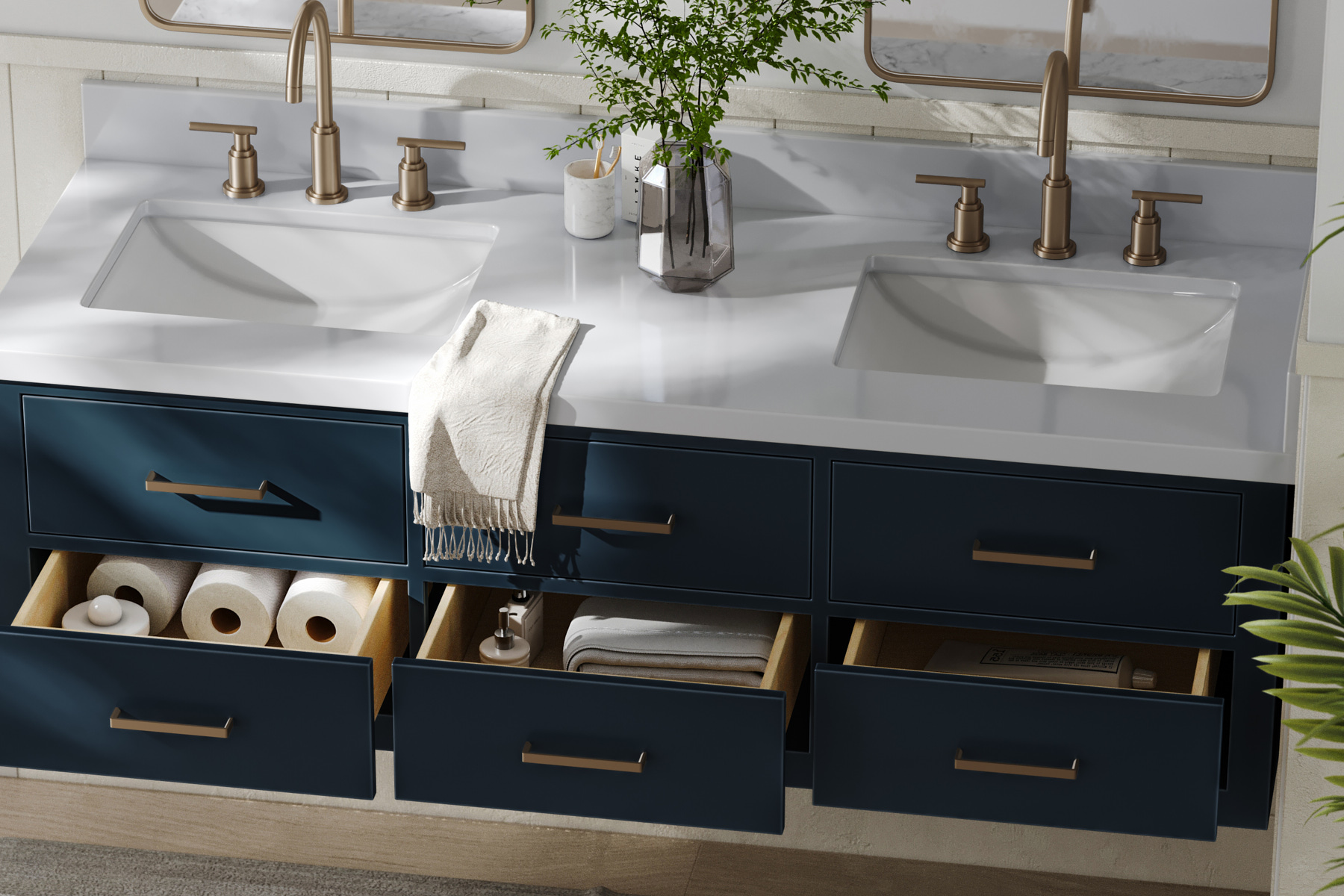
ARIEL Bath: Choose a wider vanity with more drawers, and use drawer organizers to divide the space. The extra width of a double vanity typically allows for more cabinets and drawers than a single.